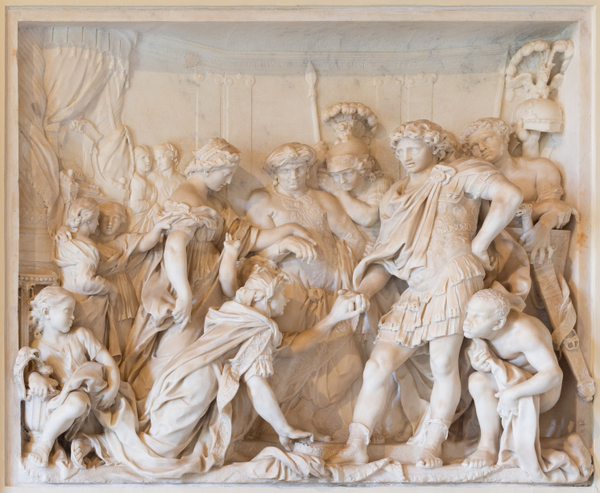
Caractuacus before Claudius
Details
- Date
- 1780
- Author / Artist
- Thomas Banks
- Dimensions
- 112 x 153 cm
- Material
- Marble
- Catalogue number
- SS.58
- Current location
- North Hall
Caratacus was a British chieftain of the Catuvellauni tribe, who resisted the Roman conquest of Britain. After his capture, Caratacus was sent to Rome as a war prize. Although a captive, he was allowed to address the Roman Senate. Tacitus records a version of his speech in which he says that his stubborn resistance made Rome’s glory in defeating him all the greater:
If the degree of my nobility and fortune had been matched by moderation in success, I would have come to this City as a friend rather than a captive, nor would you have disdained to receive with a treaty of peace one sprung from brilliant ancestors and commanding a great many nations. But my present lot, disfiguring as it is for me, is magnificent for you. I had horses, men, arms, and wealth: what wonder if I was unwilling to lose them? If you wish to command everyone, does it really follow that everyone should accept your slavery? If I were now being handed over as one who had surrendered immediately, neither my fortune nor your glory would have achieved brilliance. It is also true that in my case any reprisal will be followed by oblivion. On the other hand, if you preserve me safe and sound, I shall be an eternal example of your clemency. (Tacitus, The Annals, 12:33f)
Caratacus made such an impression that he was pardoned and allowed to live in peace in Rome. The story had come to popular attention in England as the title character of the Italian opera Carattaco by Johann Christian Bach, first performed in London in 1767 and William Mason’s play, Caratacus, of 1776. Exhibited: London, Royal Academy, 1780, no. 476.