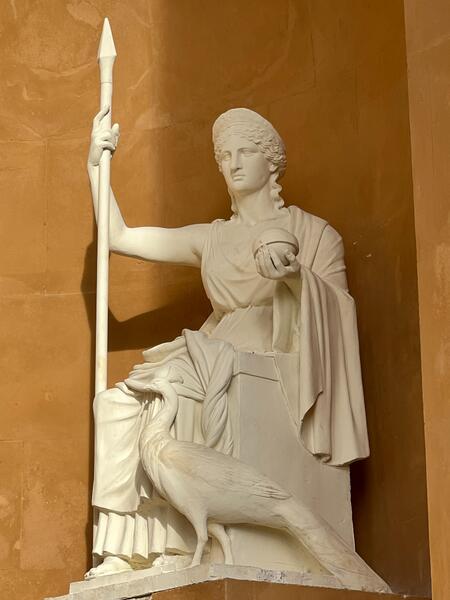
Seated Statue of Cybele
Details
- Date
- 2025
- Author / Artist
- Dimensions
- 162cm
- Material
- Portland cement
- Catalogue number
- SHPT.38
- Current location
- South Portico
Recreation of the seated statue of Cybele. The mother goddess, with many of her attributes, each signifying a different role. She wears a crown in the form of a towered wall, a symbol of her role as protectress of cities. Her right hand holds a bunch of wheat and poppy heads, a symbol of her role as a goddess of agriculture. Her most famous attribute, the lion, sits at her feet, symbolizing her power over wild animals. In her left hand she holds a tympanum with a cornucopia below. This statue’s most unusual feature is its face, which belongs to an older Roman matron, not an idealized goddess. Wealthy Roman women would frequently commission portraits of themselves depicted as if they were goddesses. Cybele is an unusual choice, however, which may indicate that this woman was a priestess in the goddess’s service. Cybele’s cult was introduced to Rome in 204 B.C. from its home in the Near East. Worship in the cult included ritual flagellation and castration; it was initially discouraged for Roman citizens. By the time this portrait was created, however, many of the cult’s wilder aspects had been tamed or eliminated. This statue was brought by the 1st Marquess of Buckingham by 1777 from Gavin Hamilton, it was sold in the 1848 sale and is now at the Getty Museum in Los Angeles.